 Add to Chrome
 Add to Firefox
 Add to Edge
Rethinking Generalization in Graph Neural Networks: A Structural Complexity Perspective
May 13, 2026
Graph neural networks (GNNs) have emerged as a fundamental tool for learning from graph-structured data, achieving strong performance across a wide range of applications. However, understanding their generalization capabilities remains challenging due to the complex structural dependencies inherent in such data. Existing generalization analyses largely follow the classical machine learning paradigm, focusing primarily on model complexity while overlooking the fundamental role of graph structure. Therefore, in this work, we systematically investigate this role by asking: does the graph structure actually influence generalization, and if so, by how much? To answer the first question and validate our intuition, we theoretically prove that incorporating more edges into the prediction process transforms the input representations to be overly accommodating to the output model, thereby inducing overfitting. To address the second question, we formulate a structural complexity measure based on the number of effective edges and derive a Rademacher complexity-based generalization bound. In doing so, we demonstrate that GNN generalization depends explicitly on structural complexity, alongside traditional parameter-dependent factors. Motivated by these theoretical findings, we propose a structural entropy regularization method. This approach controls structural complexity by regulating effective edges to balance underfitting and overfitting, ultimately improving the generalization performance of GNNs.

Development and multi-center evaluation of domain-adapted speech recognition for human-AI teaming in real-world gastrointestinal endoscopy
Apr 02, 2026Automatic speech recognition (ASR) is a critical interface for human-AI interaction in gastrointestinal endoscopy, yet its reliability in real-world clinical settings is limited by domain-specific terminology and complex acoustic conditions. Here, we present EndoASR, a domain-adapted ASR system designed for real-time deployment in endoscopic workflows. We develop a two-stage adaptation strategy based on synthetic endoscopy reports, targeting domain-specific language modeling and noise robustness. In retrospective evaluation across six endoscopists, EndoASR substantially improves both transcription accuracy and clinical usability, reducing character error rate (CER) from 20.52% to 14.14% and increasing medical term accuracy (Med ACC) from 54.30% to 87.59%. In a prospective multi-center study spanning five independent endoscopy centers, EndoASR demonstrates consistent generalization under heterogeneous real-world conditions. Compared with the baseline Paraformer model, CER is reduced from 16.20% to 14.97%, while Med ACC is improved from 61.63% to 84.16%, confirming its robustness in practical deployment scenarios. Notably, EndoASR achieves a real-time factor (RTF) of 0.005, significantly faster than Whisper-large-v3 (RTF 0.055), while maintaining a compact model size of 220M parameters, enabling efficient edge deployment. Furthermore, integration with large language models demonstrates that improved ASR quality directly enhances downstream structured information extraction and clinician-AI interaction. These results demonstrate that domain-adapted ASR can serve as a reliable interface for human-AI teaming in gastrointestinal endoscopy, with consistent performance validated across multi-center real-world clinical settings.
Data-Efficient Brushstroke Generation with Diffusion Models for Oil Painting
Mar 01, 2026Many creative multimedia systems are built upon visual primitives such as strokes or textures, which are difficult to collect at scale and fundamentally different from natural image data. This data scarcity makes it challenging for modern generative models to learn expressive and controllable primitives, limiting their use in process-aware content creation. In this work, we study the problem of learning human-like brushstroke generation from a small set of hand-drawn samples (n=470) and propose StrokeDiff, a diffusion-based framework with Smooth Regularization (SmR). SmR injects stochastic visual priors during training, providing a simple mechanism to stabilize diffusion models under sparse supervision without altering the inference process. We further show how the learned primitives can be made controllable through a Bézier-based conditioning module and integrated into a complete stroke-based painting pipeline, including prediction, generation, ordering, and compositing. This demonstrates how data-efficient primitive modeling can support expressive and structured multimedia content creation. Experiments indicate that the proposed approach produces diverse and structurally coherent brushstrokes and enables paintings with richer texture and layering, validated by both automatic metrics and human evaluation.
Understanding the Role of Rehearsal Scale in Continual Learning under Varying Model Capacities
Feb 24, 2026Rehearsal is one of the key techniques for mitigating catastrophic forgetting and has been widely adopted in continual learning algorithms due to its simplicity and practicality. However, the theoretical understanding of how rehearsal scale influences learning dynamics remains limited. To address this gap, we formulate rehearsal-based continual learning as a multidimensional effectiveness-driven iterative optimization problem, providing a unified characterization across diverse performance metrics. Within this framework, we derive a closed-form analysis of adaptability, memorability, and generalization from the perspective of rehearsal scale. Our results uncover several intriguing and counterintuitive findings. First, rehearsal can impair model's adaptability, in sharp contrast to its traditionally recognized benefits. Second, increasing the rehearsal scale does not necessarily improve memory retention. When tasks are similar and noise levels are low, the memory error exhibits a diminishing lower bound. Finally, we validate these insights through numerical simulations and extended analyses on deep neural networks across multiple real-world datasets, revealing statistical patterns of rehearsal mechanisms in continual learning.
Exploring the Impact of Parameter Update Magnitude on Forgetting and Generalization of Continual Learning
Feb 24, 2026The magnitude of parameter updates are considered a key factor in continual learning. However, most existing studies focus on designing diverse update strategies, while a theoretical understanding of the underlying mechanisms remains limited. Therefore, we characterize model's forgetting from the perspective of parameter update magnitude and formalize it as knowledge degradation induced by task-specific drift in the parameter space, which has not been fully captured in previous studies due to their assumption of a unified parameter space. By deriving the optimal parameter update magnitude that minimizes forgetting, we unify two representative update paradigms, frozen training and initialized training, within an optimization framework for constrained parameter updates. Our theoretical results further reveals that sequence tasks with small parameter distances exhibit better generalization and less forgetting under frozen training rather than initialized training. These theoretical insights inspire a novel hybrid parameter update strategy that adaptively adjusts update magnitude based on gradient directions. Experiments on deep neural networks demonstrate that this hybrid approach outperforms standard training strategies, providing new theoretical perspectives and practical inspiration for designing efficient and scalable continual learning algorithms.
Bipartite Graph Attention-based Clustering for Large-scale scRNA-seq Data
Feb 07, 2026scRNA-seq clustering is a critical task for analyzing single-cell RNA sequencing (scRNA-seq) data, as it groups cells with similar gene expression profiles. Transformers, as powerful foundational models, have been applied to scRNA-seq clustering. Their self-attention mechanism automatically assigns higher attention weights to cells within the same cluster, enhancing the distinction between clusters. Existing methods for scRNA-seq clustering, such as graph transformer-based models, treat each cell as a token in a sequence. Their computational and space complexities are $\mathcal{O}(n^2)$ with respect to the number of cells, limiting their applicability to large-scale scRNA-seq datasets.To address this challenge, we propose a Bipartite Graph Transformer-based clustering model (BGFormer) for scRNA-seq data. We introduce a set of learnable anchor tokens as shared reference points to represent the entire dataset. A bipartite graph attention mechanism is introduced to learn the similarity between cells and anchor tokens, bringing cells of the same class closer together in the embedding space. BGFormer achieves linear computational complexity with respect to the number of cells, making it scalable to large datasets. Experimental results on multiple large-scale scRNA-seq datasets demonstrate the effectiveness and scalability of BGFormer.
LLM-Guided Diagnostic Evidence Alignment for Medical Vision-Language Pretraining under Limited Pairing
Feb 07, 2026Most existing CLIP-style medical vision--language pretraining methods rely on global or local alignment with substantial paired data. However, global alignment is easily dominated by non-diagnostic information, while local alignment fails to integrate key diagnostic evidence. As a result, learning reliable diagnostic representations becomes difficult, which limits their applicability in medical scenarios with limited paired data. To address this issue, we propose an LLM-Guided Diagnostic Evidence Alignment method (LGDEA), which shifts the pretraining objective toward evidence-level alignment that is more consistent with the medical diagnostic process. Specifically, we leverage LLMs to extract key diagnostic evidence from radiology reports and construct a shared diagnostic evidence space, enabling evidence-aware cross-modal alignment and allowing LGDEA to effectively exploit abundant unpaired medical images and reports, thereby substantially alleviating the reliance on paired data. Extensive experimental results demonstrate that our method achieves consistent and significant improvements on phrase grounding, image--text retrieval, and zero-shot classification, and even rivals pretraining methods that rely on substantial paired data.
Large-Scale Terminal Agentic Trajectory Generation from Dockerized Environments
Feb 03, 2026Training agentic models for terminal-based tasks critically depends on high-quality terminal trajectories that capture realistic long-horizon interactions across diverse domains. However, constructing such data at scale remains challenging due to two key requirements: \textbf{\emph{Executability}}, since each instance requires a suitable and often distinct Docker environment; and \textbf{\emph{Verifiability}}, because heterogeneous task outputs preclude unified, standardized verification. To address these challenges, we propose \textbf{TerminalTraj}, a scalable pipeline that (i) filters high-quality repositories to construct Dockerized execution environments, (ii) generates Docker-aligned task instances, and (iii) synthesizes agent trajectories with executable validation code. Using TerminalTraj, we curate 32K Docker images and generate 50,733 verified terminal trajectories across eight domains. Models trained on this data with the Qwen2.5-Coder backbone achieve consistent performance improvements on TerminalBench (TB), with gains of up to 20\% on TB~1.0 and 10\% on TB~2.0 over their respective backbones. Notably, \textbf{TerminalTraj-32B} achieves strong performance among models with fewer than 100B parameters, reaching 35.30\% on TB~1.0 and 22.00\% on TB~2.0, and demonstrates improved test-time scaling behavior. All code and data are available at https://github.com/Wusiwei0410/TerminalTraj.
One-shot synthesis of rare gastrointestinal lesions improves diagnostic accuracy and clinical training
Dec 30, 2025Rare gastrointestinal lesions are infrequently encountered in routine endoscopy, restricting the data available for developing reliable artificial intelligence (AI) models and training novice clinicians. Here we present EndoRare, a one-shot, retraining-free generative framework that synthesizes diverse, high-fidelity lesion exemplars from a single reference image. By leveraging language-guided concept disentanglement, EndoRare separates pathognomonic lesion features from non-diagnostic attributes, encoding the former into a learnable prototype embedding while varying the latter to ensure diversity. We validated the framework across four rare pathologies (calcifying fibrous tumor, juvenile polyposis syndrome, familial adenomatous polyposis, and Peutz-Jeghers syndrome). Synthetic images were judged clinically plausible by experts and, when used for data augmentation, significantly enhanced downstream AI classifiers, improving the true positive rate at low false-positive rates. Crucially, a blinded reader study demonstrated that novice endoscopists exposed to EndoRare-generated cases achieved a 0.400 increase in recall and a 0.267 increase in precision. These results establish a practical, data-efficient pathway to bridge the rare-disease gap in both computer-aided diagnostics and clinical education.
Shared Object Manipulation with a Team of Collaborative Quadrupeds
Oct 01, 2025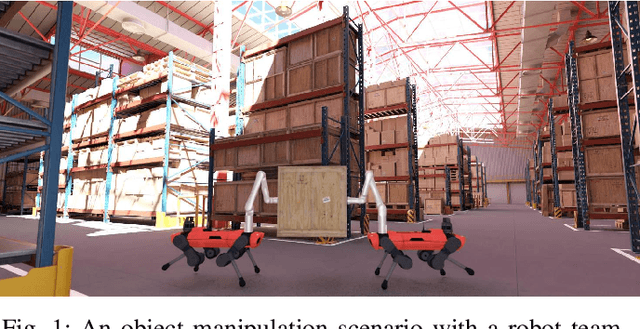
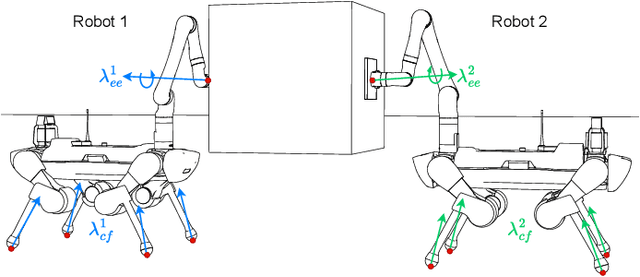
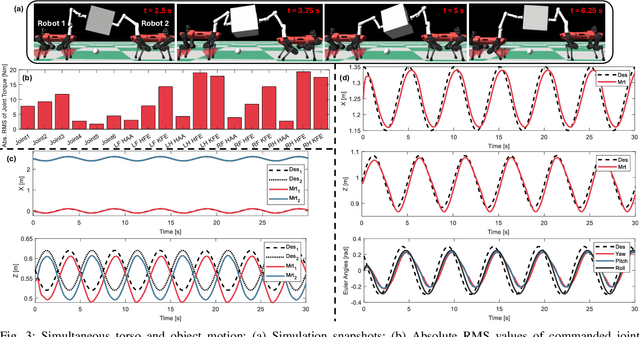
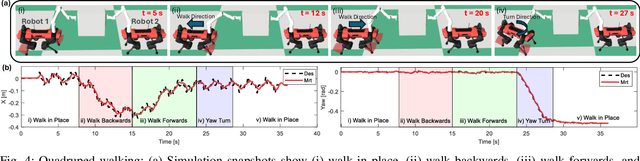
Utilizing teams of multiple robots is advantageous for handling bulky objects. Many related works focus on multi-manipulator systems, which are limited by workspace constraints. In this paper, we extend a classical hybrid motion-force controller to a team of legged manipulator systems, enabling collaborative loco-manipulation of rigid objects with a force-closed grasp. Our novel approach allows the robots to flexibly coordinate their movements, achieving efficient and stable object co-manipulation and transport, validated through extensive simulations and real-world experiments.